The Hopeful Science Most Men With Thinning Hair Never Hear
Ask a man what's happening on top of his head and he'll say the hair is dying. Ask a researcher who studies follicles and you get a more complicated — and more hopeful — answer.
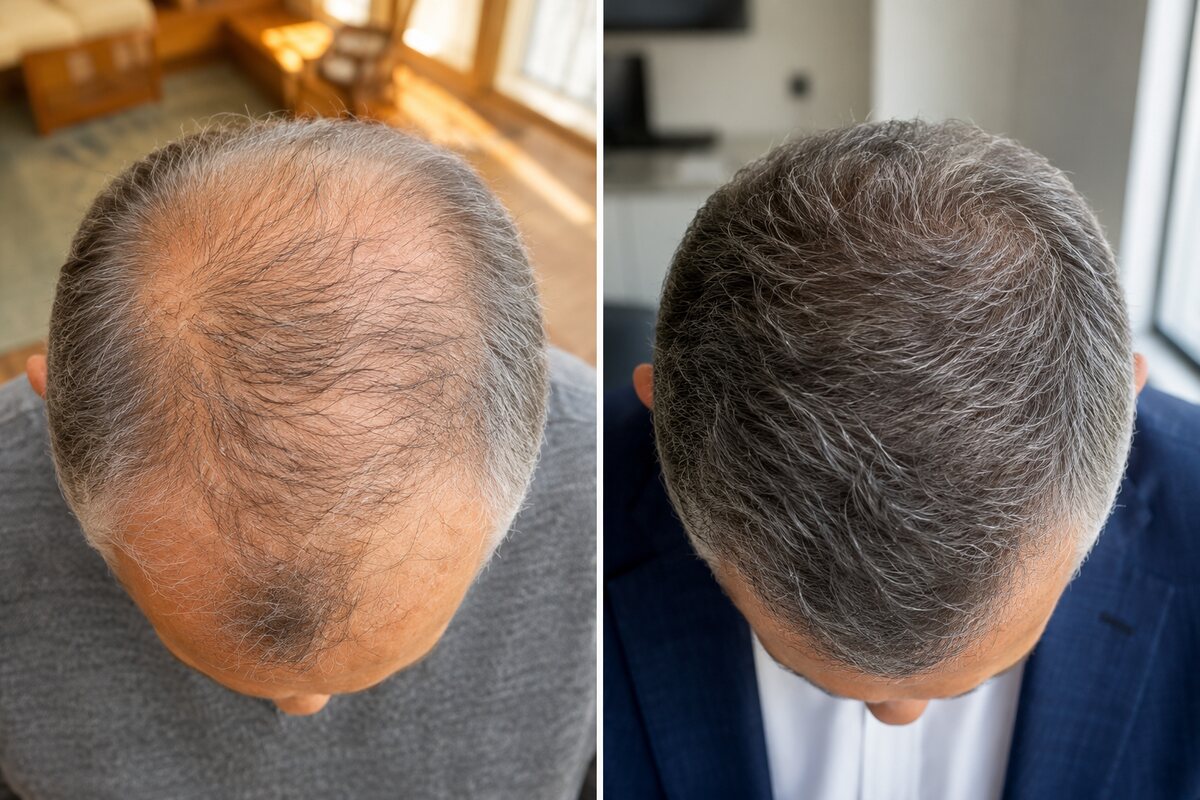
For a condition that reaches most men eventually, male-pattern hair loss is strangely misunderstood by the very people living through it. Ask the average man what is happening on top of his head and he will tell you, with a certain grim confidence, that the hair is dying. Ask a researcher who actually studies hair follicles and you get a more complicated answer, and a considerably more hopeful one.
That gap between what men believe and what the science says is not academic. It is the difference between a problem a man spends the rest of his life quietly hiding, and a problem he might genuinely be able to act on. And almost no one ever explains it to him.
The follicle doesn't usually die. It powers down.
In the most common form of age- and genetics-related thinning, known clinically as androgenetic alopecia, the follicle is not destroyed. What happens is slower and subtler than death. With each successive growth cycle the follicle produces a slightly finer, slightly shorter, slightly weaker hair, a process called miniaturisation, until the strand it manages to push out is so thin and so pale that the scalp simply reads as bare. But the structure that grows the hair is, in most cases, still there. It has throttled down to almost nothing, like a machine left idling so low you'd swear it was switched off.
This is not a fringe or fringe-friendly reading of the evidence. A systematic review published through the U.S. National Library of Medicine notes that in this type of loss the follicle's stem cells are generally preserved, which is the specific reason its authors describe the condition as potentially reversible rather than permanent. [1] A second review in the same body of literature, surveying stem-cell approaches to hair growth, frames the central project of the entire field as whether those dormant follicles can be coaxed back into a productive cycle. [2]
So the thing a great many men have written off as gone is, in fact, still alive and idling. Researchers have spent the better part of a decade asking what it would take to wake it back up.
The thing a great many men have written off as gone is, in fact, still alive — and idling.
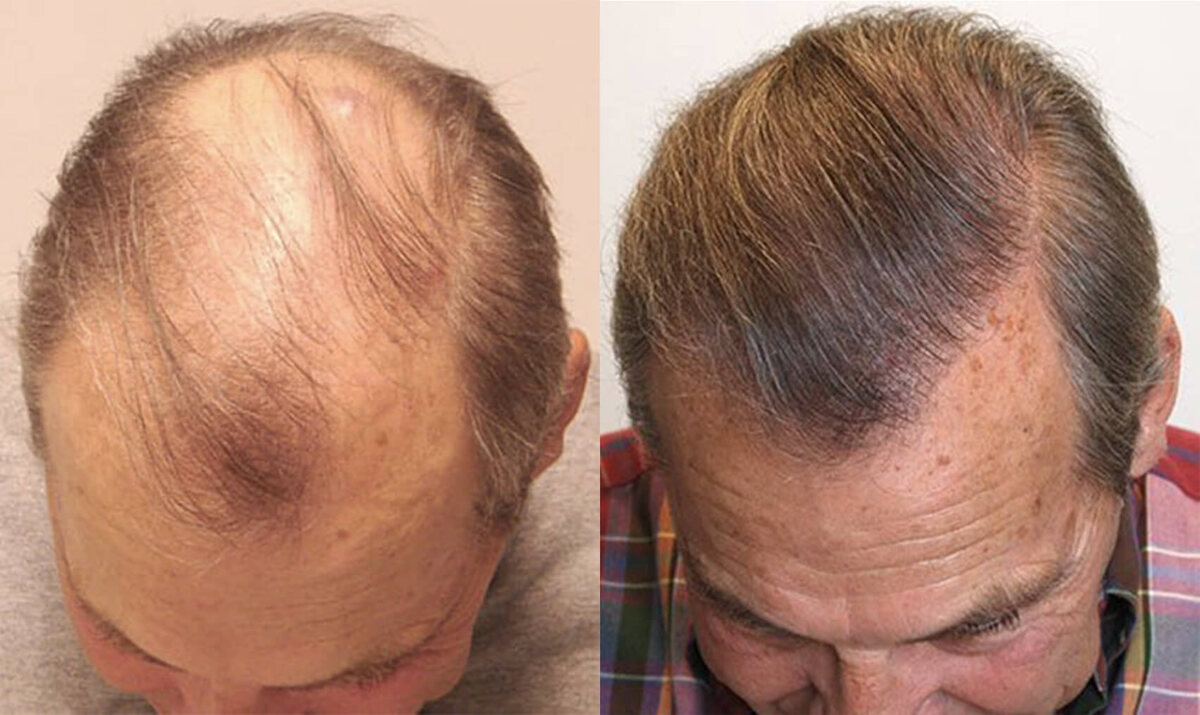
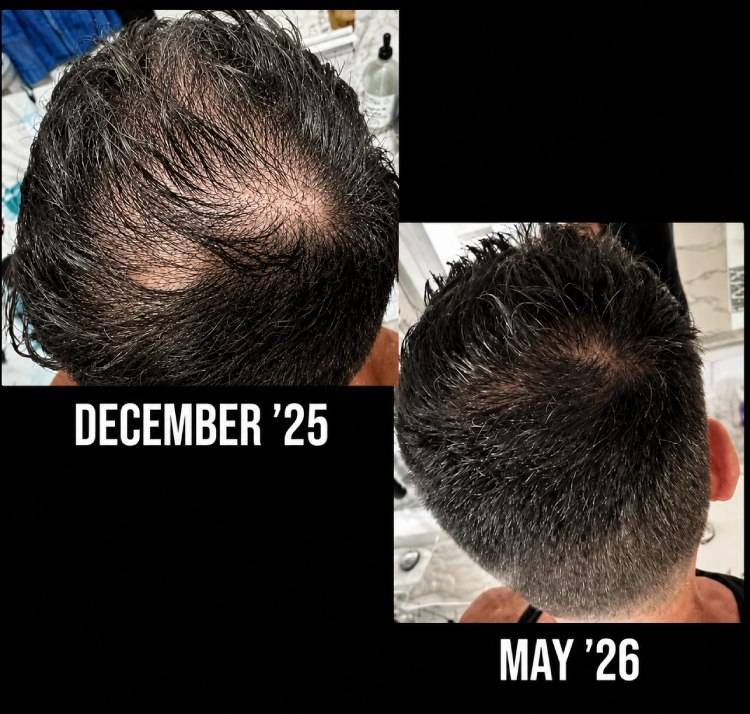
Real customer photos
These are the photos men are comparing at home.
Why so many men give up on a problem that hasn't given up on them
There is a psychology here worth pausing on, because it explains a great deal of wasted years.
"It's over" is, perversely, a comfortable belief. It asks nothing of you. It closes the file. A man who decides his hair is simply gone gets to stop hoping, stop trying, stop spending, and stop feeling the small daily sting of a thing he is, culturally, not even allowed to admit bothers him. There is no socially acceptable way for a man to grieve his hairline, so the grief goes underground and reroutes itself into a hundred quiet logistics: the chosen seat, the volunteered camera duty, the cap that is supposedly about the sun. Surrender, in that light, feels like maturity.
The trouble is that the comfortable belief is, for many men, simply factually wrong. They are managing the symptoms of a system that has not actually failed, only stalled, and the management costs them more, in money and in quiet self-erasure, than addressing the cause might have.
Why the bathroom cabinet disappoints
This also explains why the products most men reach for first tend to leave them feeling like they're running to stand still. The thickening shampoos, the volumising foams, the fibre powders all work, more or less, on the appearance of the hair that remains. They coat the strand, plump it, change the way it scatters light. The effect is genuine and entirely cosmetic, and it persists for exactly as long as a man keeps repurchasing it. None of it speaks to the follicle that quieted down in the first place. It is, to borrow a phrase, all paint and no engine.
The more interesting research moved in the opposite direction altogether: not disguising the hair that is left, but acting on the follicle itself and the scalp environment around it.
The ingredient question
Two families of ingredient have accumulated the most credible support, and both sit at the centre of the current generation of at-home treatments.
The first is plant-derived stem cell extract. In laboratory work, a cultured apple-derived stem cell extract was shown to extend the lifespan of isolated human hair follicles, keeping them in their active phase longer than they would otherwise manage. [4] It is important to be precise about what that evidence is and is not: it is cellular and ex-vivo work, not a clinical trial of a finished consumer product. But it is a real, documented effect, which is already more than most of this category can honestly claim.
The second family is peptides, and here the ground is firmer. Copper-binding peptides such as GHK have been studied specifically for their effect on the dermal papilla, the cluster of cells at the base of the follicle that governs growth, with the research describing them as supporting those cells and helping to prolong the active growth phase. [6] A broader overview of short peptides for hair loss arrives at a similar conclusion about the underlying mechanism. [7]
None of this amounts to a cure, and any company that frames it that way deserves your suspicion. What it amounts to is a plausible, evidence-backed reason to believe that a dormant follicle can sometimes be nudged back toward producing real hair.
What you get
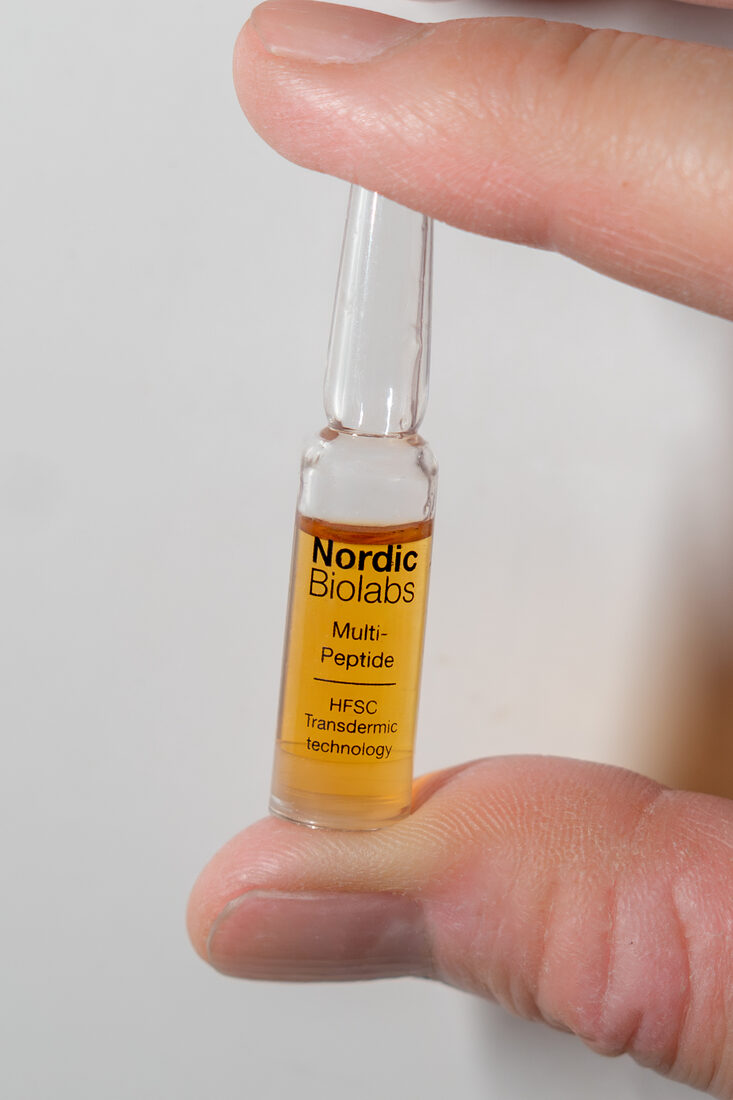
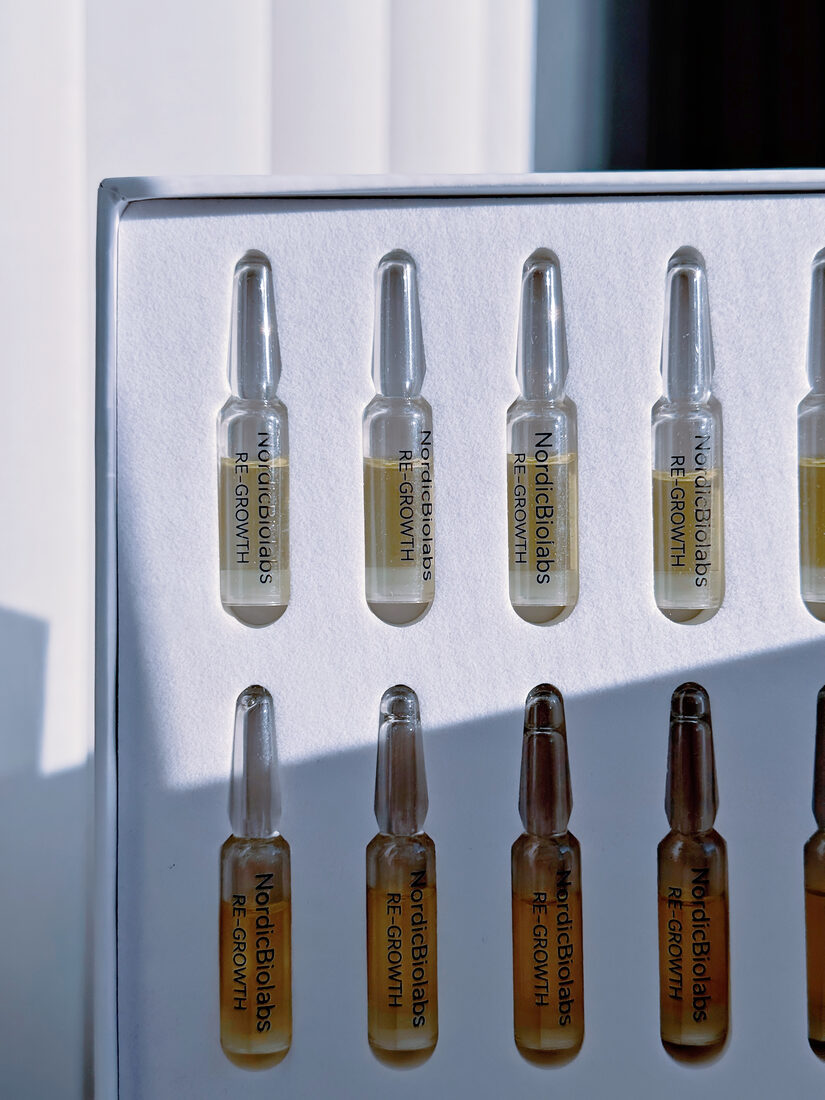
Single-use ampoules. Two minutes a morning.
What progress actually looks like, and how long it takes
This is the part most men never hear, and it is the reason a great many give up right before anything happens.
Hair grows on a biological clock, not a consumer one. A follicle that has been miniaturising for years does not snap back in a fortnight. In practice, the earliest signs reported tend to be modest and easy to miss, and they are rarely the thing men are watching for. Often the first change is simply less hair coming away in the shower or on the pillow, the slowing of a loss rather than the arrival of a gain. New growth, when it comes, tends to show up as fine, soft hairs along the hairline that you only catch in raking light, well before anything a man would describe as "thicker." This is why serious programmes are structured around a cycle of roughly ninety days, and why the men who abandon ship at week two or three so reliably conclude that "nothing works." They left before the run was complete.
A case in point
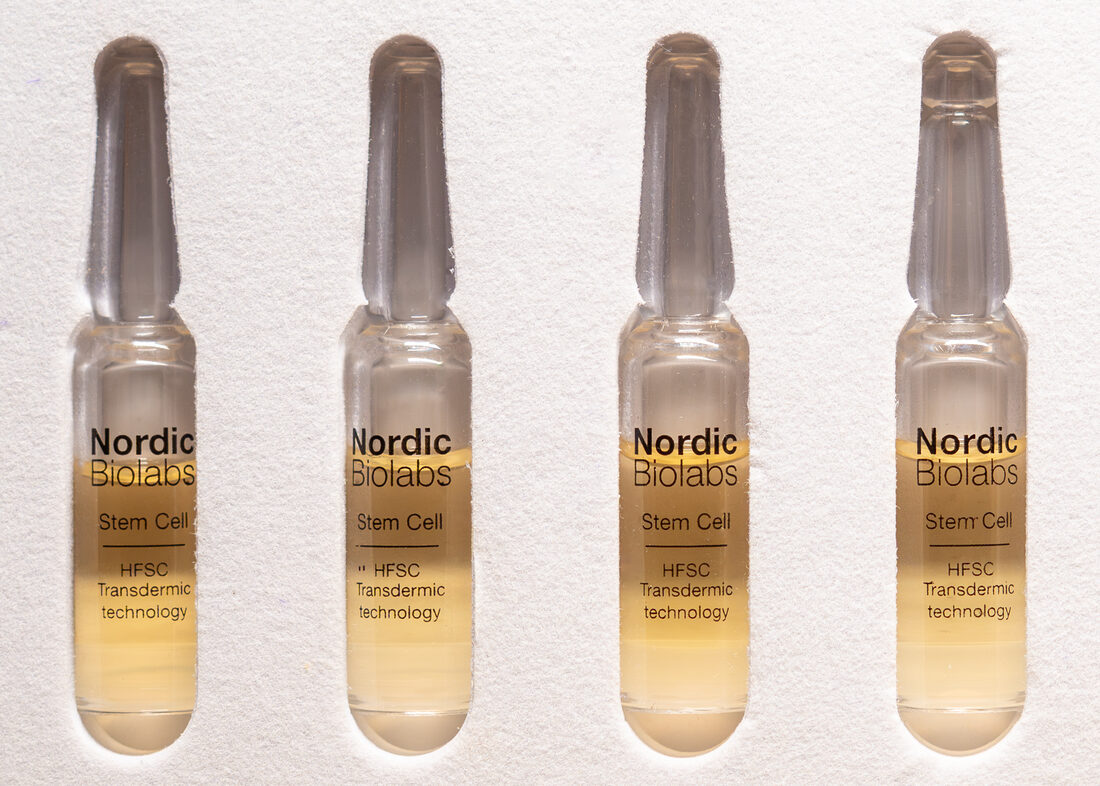
Among the products built on this premise is a topical from Nordic Biolabs called the Hair Cycle Solution, which is more useful here as a representative example of how the category now operates than as an endorsement.
It pairs the two ingredient families described above in single-dose ampoules applied to a dry scalp on a five-days-on, two-days-off schedule. The company reports that in its own testing of 320 people aged 30 to 70, 85.7 percent saw new hair within ninety days. That figure should be read for precisely what it is, an internal company result rather than an independent controlled trial, and weighted with appropriate caution.
A fair-minded account also has to mark the outer limits of the evidence. The strongest, trial-grade results in hair regeneration tend to come from clinical procedures such as stem-cell-derived injectable therapies, a different and considerably more invasive category than any serum in a box. [3] A topical is not that, and shouldn't be sold as though it were. What the at-home approach offers instead is a low-stakes application of ingredients whose mechanisms are documented, on the clear understanding that results vary and that some men will not respond at all.
What keeps the proposition reasonable rather than reckless is the structure around it. Nordic Biolabs attaches a 90-day money-back guarantee: a customer documents a before photo, completes the roughly ninety-day cycle, and is refunded if there is no visible change, with a specialist consultation included near the end of the cycle. The practical effect is to shift the great majority of the risk off the buyer and onto the company, which is, generally, what a company does when it has some confidence in the product and some interest in repeat customers rather than one-time marks.
What a reasonable person should take from this
The honest summary is unglamorous, which is usually a sign it sits close to the truth.
Age-related thinning is, for most men, not the closed door they assume it to be. The follicle is frequently dormant rather than dead. There are ingredients with real, if still early, evidence behind them for supporting that follicle, and there are at-home products built around those ingredients that can be trialled at modest cost and, with a guarantee in place, modest risk. None of it is magic. The timeline is measured in months rather than weeks. A share of men will see little. But the reflexive conclusion that nothing can be done is, according to the actual research, simply wrong for a great many of the men who have quietly resigned themselves to it.
For anyone inclined to look more closely, the studies cited here are public and worth reading in full, and the Hair Cycle Solution and the terms of its guarantee are documented on the company's own site.
Mentioned in this report
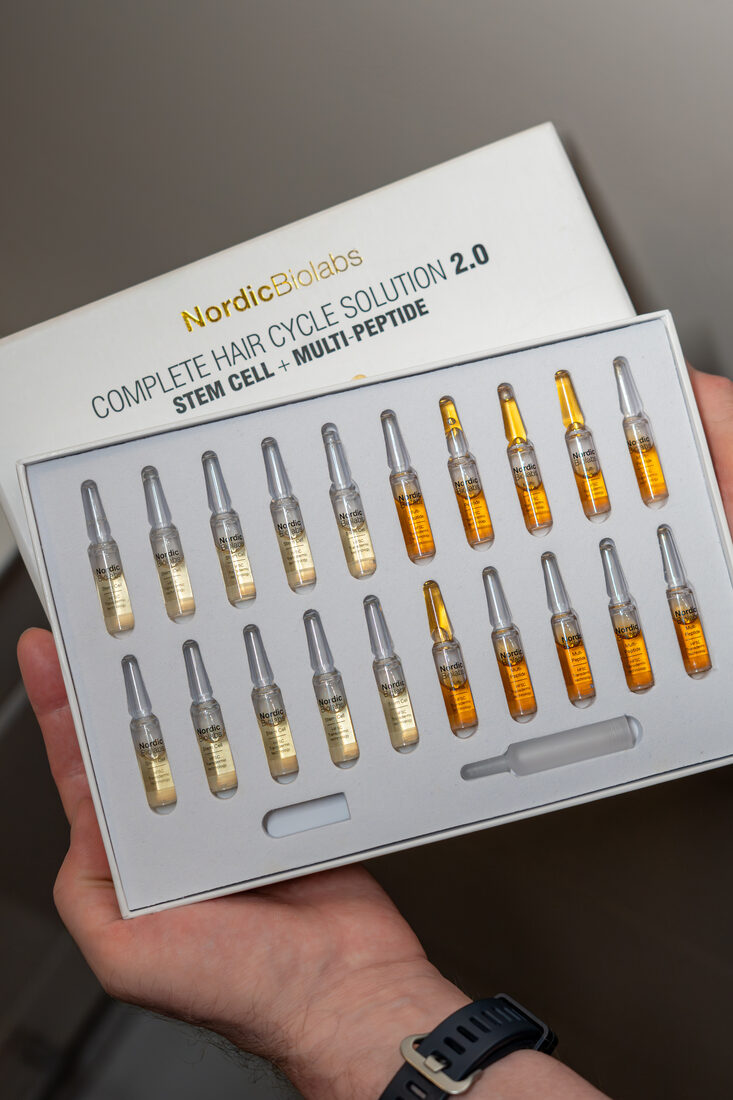
STEM Cell Complete Hair Cycle Solution 2.0
A two-part topical ampoule routine built around the full hair cycle, not a one-night cosmetic trick.
- 90-day money-back
- ≈2 min a morning
- Topical · external use
- 1-Month20 ampoules · $119/mo Save 56%$119
- 3-Month60 ampoules · $82/mo Save 63%$247
- 6-Month · Full Cycle120 ampoules · $75/mo Save 70%$447
Sponsored feature · Advertorial. Sponsored feature · Advertorial.
These statements have not been evaluated by the FDA. The product discussed is a topical for external use only and is not intended to diagnose, treat, cure, or prevent any disease. The 85.7% figure reflects a company study; individual results vary.
Results may vary; individual results are not typical. The 85.7% figure reflects a company study of 320 participants aged 30–70 and is not a guarantee of results.
These statements have not been evaluated by the FDA. The product discussed is a topical for external use only and is not intended to diagnose, treat, cure, or prevent any disease.
Scientific sources
Public NLM/PMC sources for ingredient-level evidence and follicle biology. Injectable stem-cell papers are category context, not claims about this topical.
- PMC10047891 · Human Stem Cell Use in Androgenetic Alopecia: A Systematic Review
- PMC10174680 · Stem Cell Applications in Human Hair Growth: A Literature Review
- PMC10863936 · Autologous Stem Cell-derived Therapies for AGA: Systematic Review of RCTs
- PMC5674215 · Plant stem cells in cosmetics: current trends and future directions
- PMC11603400 · New Plant Extracts Exert Complementary Anti-Hair Loss Properties
- PMC4969472 · Efficacy of a Complex of 5-ALA and GHK Peptide on Hair Growth
- PMC13113319 · Overview of Short Peptides for Hair Loss